 SEPS
Society for Evolutionary Parasite Systematics
SEPSM. R. Dwyer
Research and technical report. No validated end-to-end identification performance claimed.
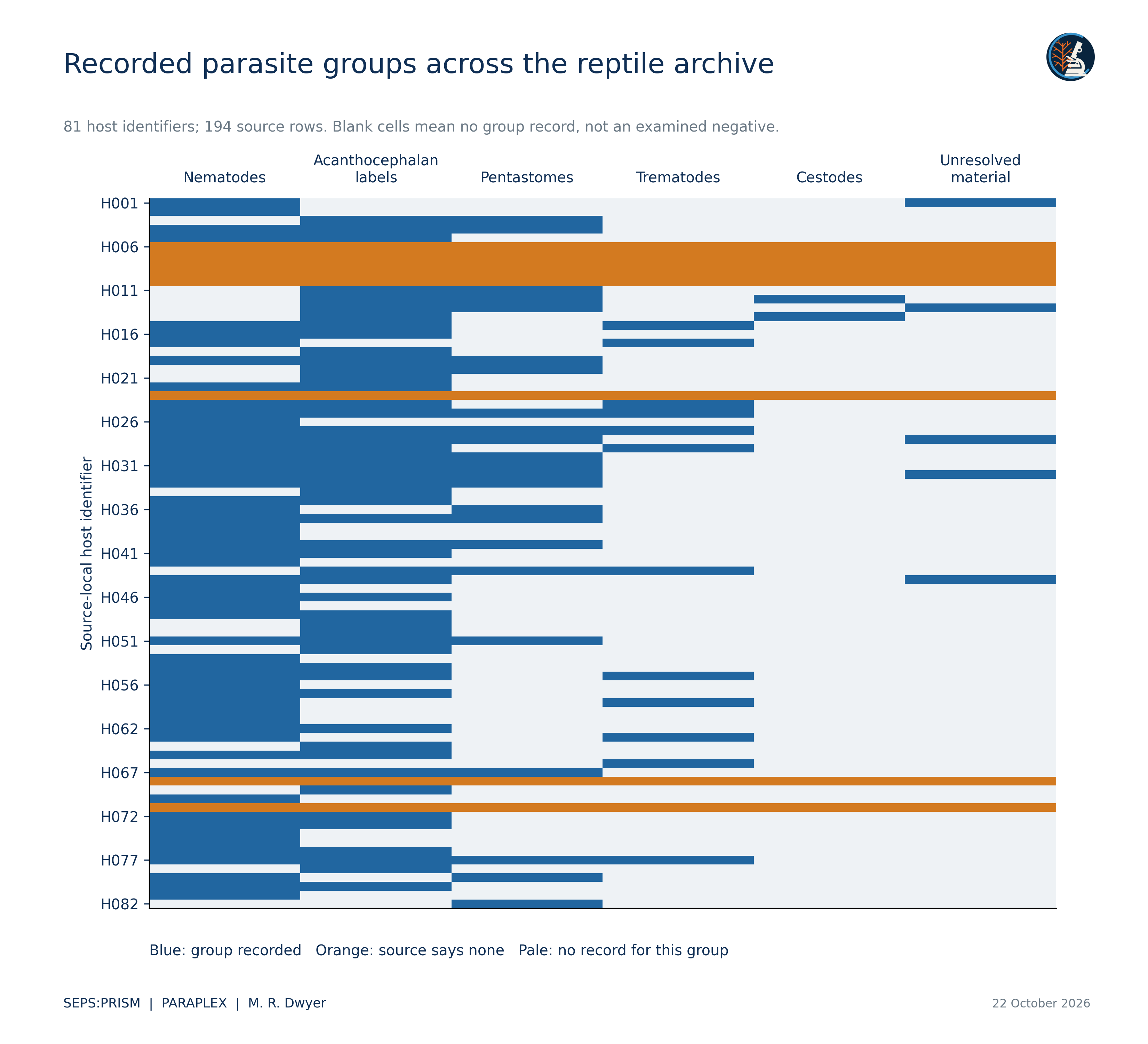
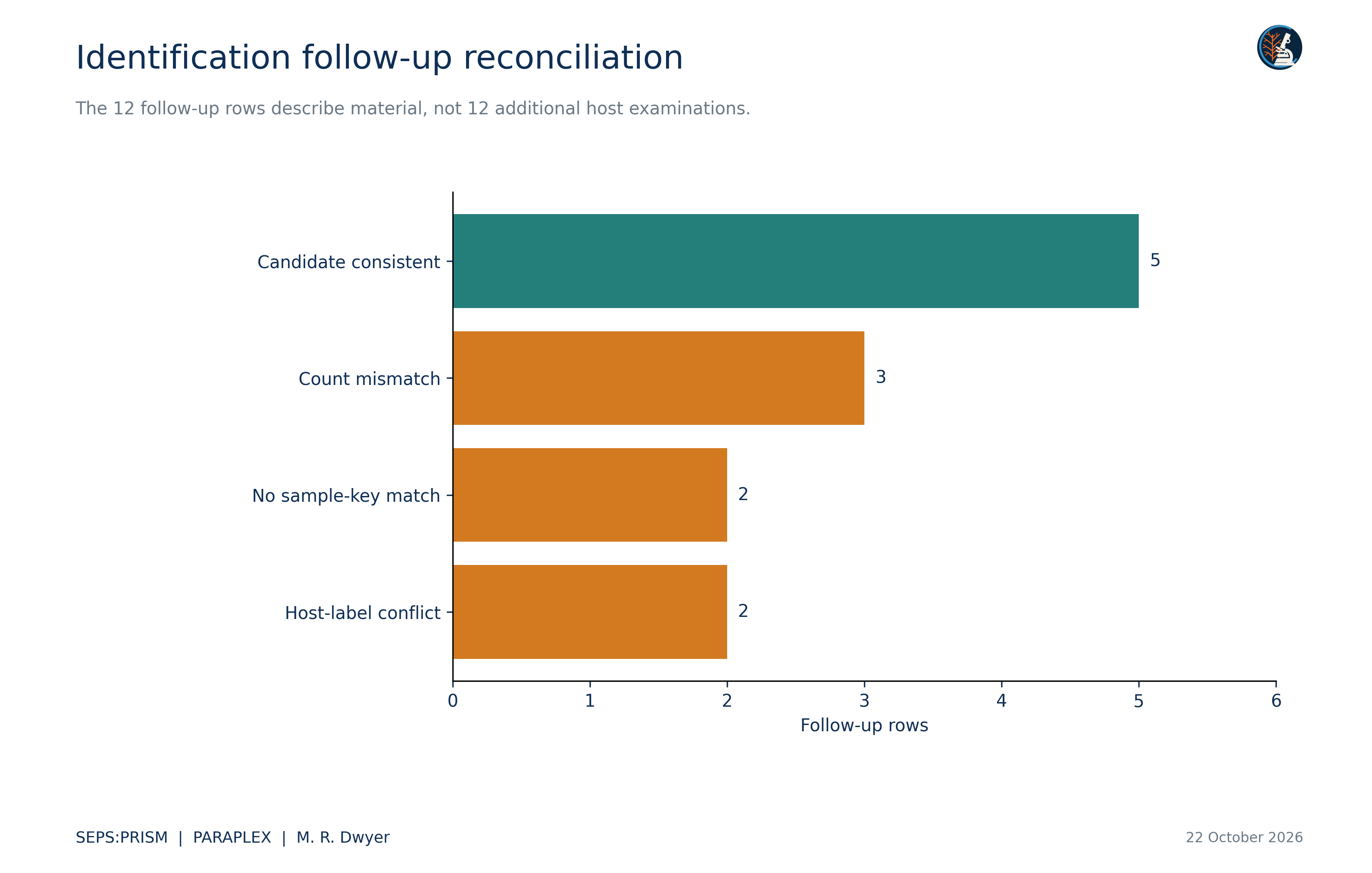
We apply the PARAPLEX ecological layer of SEPS:PRISM to 194 reptile observation rows in the recovered necropsy master workbook. The rows identify 81 hosts. Seventy-three hosts have positive parasite-group records and eight have explicit none entries. Forty-seven hosts have records in at least two broad groups. We retain unknown group cells and do not estimate population prevalence. The pentastome subtotal comprises 33 recorded organisms across 20 Basiliscus vittatus hosts, two across two Anolis equestris hosts and three in one Thamnophis sauritus. The first two components reconcile the 35-organism positive lizard summary at aggregate level. We preserve five repeated sample keys and separate 12 follow-up identification rows from new examinations. Five follow-up rows have candidates with agreeing host labels and counts; two have host-label conflicts, three have count mismatches and two lack a sample-key match. The resulting figures and tables support reproducible descriptions of the archive while identifying exactly which links and observation fields constrain ecological inference.
We use PARAPLEX to connect specimen evidence with host-level ecological questions while preserving the meaning of each source row. PARAPLEX expands Parasite Assemblage and Relationship Analysis across Populations, Landscapes, and Ecological eXchange (Dwyer, 2026e). FieldView or direct import supplies acquisition context. TEGUMENT and HookFuse retain image and morphometric evidence. FUZZARIA retains identification limits and contradictions. PARAPLEX then evaluates ecological quantities only under their own sampling and observation requirements (Dwyer, 2026a).
This report executes a descriptive implementation rather than a fitted community or transmission model. The accompanying Python code reads the preserved workbook, creates source-local row identifiers and generates the tables and figures. We release the exact grouping rules and candidate-link decisions so that a revised determination can propagate transparently through the analysis.
We read Sheet1 rows 2 through 195 as the main reptile series. We retain the six amphibian notes in rows 210 through 215 and the 12 identification follow-ups in rows 220 through 231 as separate sections. Row 219 labels an identification date field and does not describe an organism. These distinctions matter because the worksheet includes several record types under one layout (Fall2019_Fall2023_NecropsyData_MASTER(1), n.d.).
We assign NCX-R followed by the original worksheet row to each reptile observation. NCX-H followed by the original host number identifies a host within this source section. The source contains 81 distinct reptile host numbers among 1 through 82, with no record for number 60. We do not infer a missing host examination. Numeric host identifier 6 also occurs in the separate amphibian section, which illustrates why a bare number cannot serve as a global specimen key.
The main series includes 70 hosts labeled Basiliscus vittatus, five labeled Anolis sageri, three labeled Anolis equestris, two labeled Anolis and one labeled Thamnophis sauritus. We preserve the source spelling Anolis sageri without silently imposing a revised identification. Host NCX-H025 has six different date values from 10 through 15 September 2021. We preserve the date conflict and use only its consistent year for descriptive coverage. We do not convert these dates into six independent examinations.
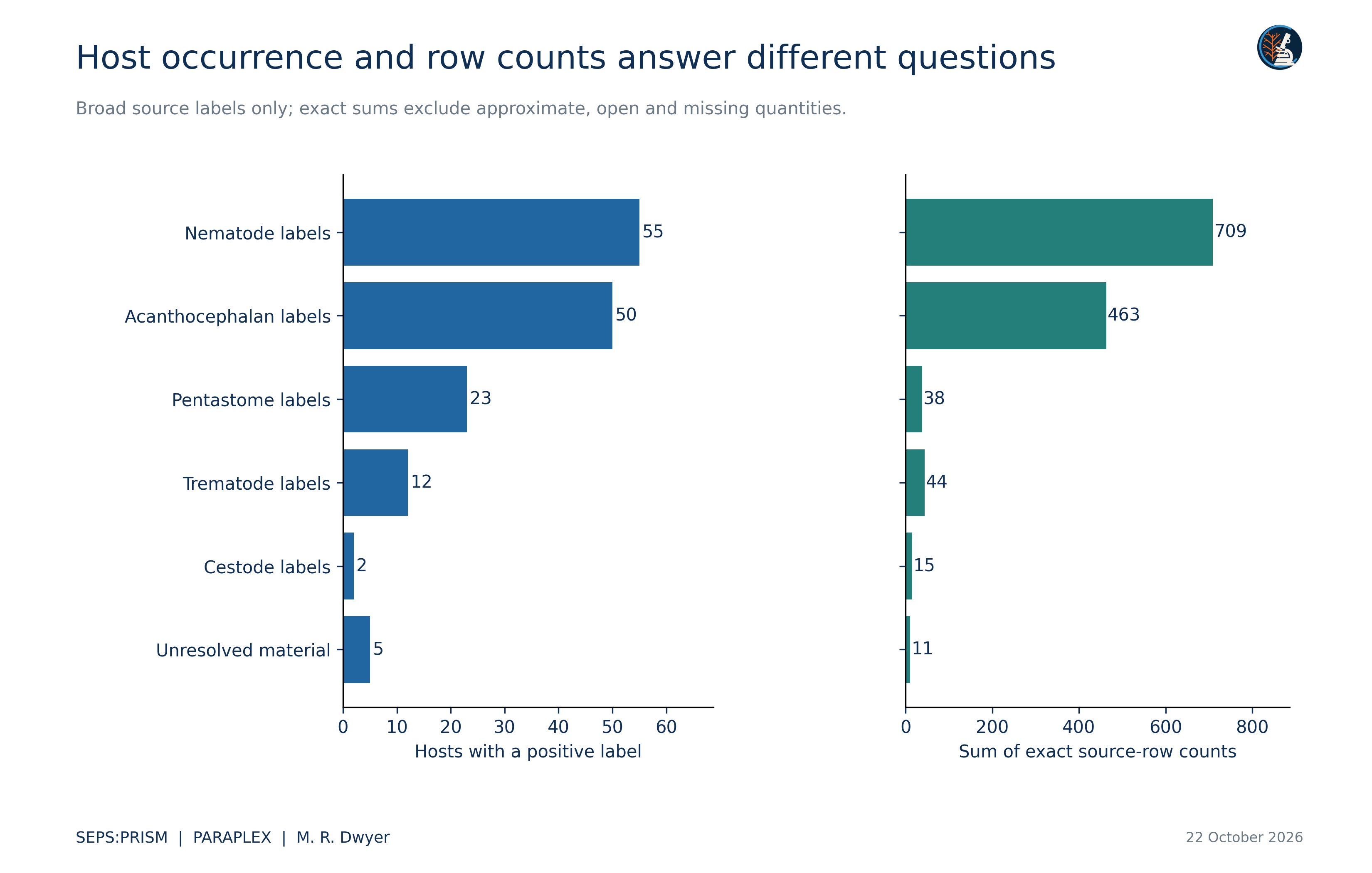
We map source terms into six broad documentary groups: nematode labels, acanthocephalan labels, pentastome labels, trematode labels, cestode labels and unresolved material. The group crosswalk retains every original term. We map ordinary cystacanth spelling variants to the acanthocephalan group. We retain the ambiguous cysticanths or advanced cestodes entry and the weird cysticanth entry as unresolved material. These groups are not species and their count does not estimate parasite species richness.
The 194 rows contain 182 numeric count cells, three unambiguous textual counts, one approximate quantity, one open quantity and seven unrecorded quantities. We parse 13sm and 1lg as 14, 1 tiny as one, and two adults plus one juvenile as three. We retain ca 15 as approximate and 1000s+ as open. We do not convert the seven blank count cells into zeros. Six of those blanks accompany none labels, while one accompanies an unspecified cyst record. Two additional none entries explicitly contain zero.
 (1)
S_j sums exact values across records in group j. Its unit is the recorded source-row count, because independent review has not excluded overlap among recovery lots. A duplicate sample key does not justify deleting a row: it may denote reused numbering, mixed contents or repeated recovery. Conversely, an exact-looking integer cannot establish that all rows count disjoint organisms. We retain the five colliding sample keys in a dedicated reconciliation table.
Table 1. Counts under explicit documentary units
| Source group | Positive hosts | Rows | Exact row sum |
|---|---|---|---|
| Nematode labels | 55 | 81 | 709 |
| Acanthocephalan labels | 50 | 53 | 463 |
| Pentastome labels | 23 | 28 | 38 |
| Trematode labels | 12 | 17 | 44 |
| Cestode labels | 2 | 2 | 15 |
| Unresolved material | 5 | 5 | 11 |
The groups overlap within hosts. Exact row sums omit approximate, open and missing quantities. They do not estimate independently verified total parasite burdens.
 (2)
B_hj is a documentary indicator. Its zero means that the ledger contains no positive record for that host and group. It does not mean that an adequate examination excluded the group. The delivered ecological matrix therefore uses one for a positive record, zero for an explicit host-level none entry and NA for an unrecorded group. Even an explicit none entry does not document complete organ coverage by itself. The workbook describes incomplete examinations in several notes, including an unexamined coelom and an unexamined small intestine.
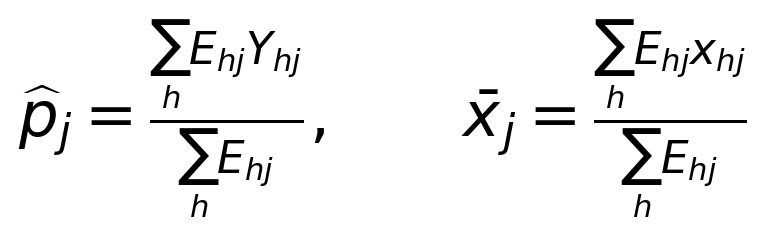 (3)
E_hj must identify eligible hosts with an examination adequate for target j. Y_hj must represent the defined detection outcome and x_hj must represent the compatible individual count. Population prevalence, mean abundance and mean intensity require these biological units and denominators (Bush et al., 1997). The present source does not establish the full E matrix or unique individual counts. We therefore report 73 positive-record hosts and eight none-only hosts as archive properties. We do not relabel 73 divided by 81 as population prevalence or use blank matrix cells as ecological zeros.
 (4)
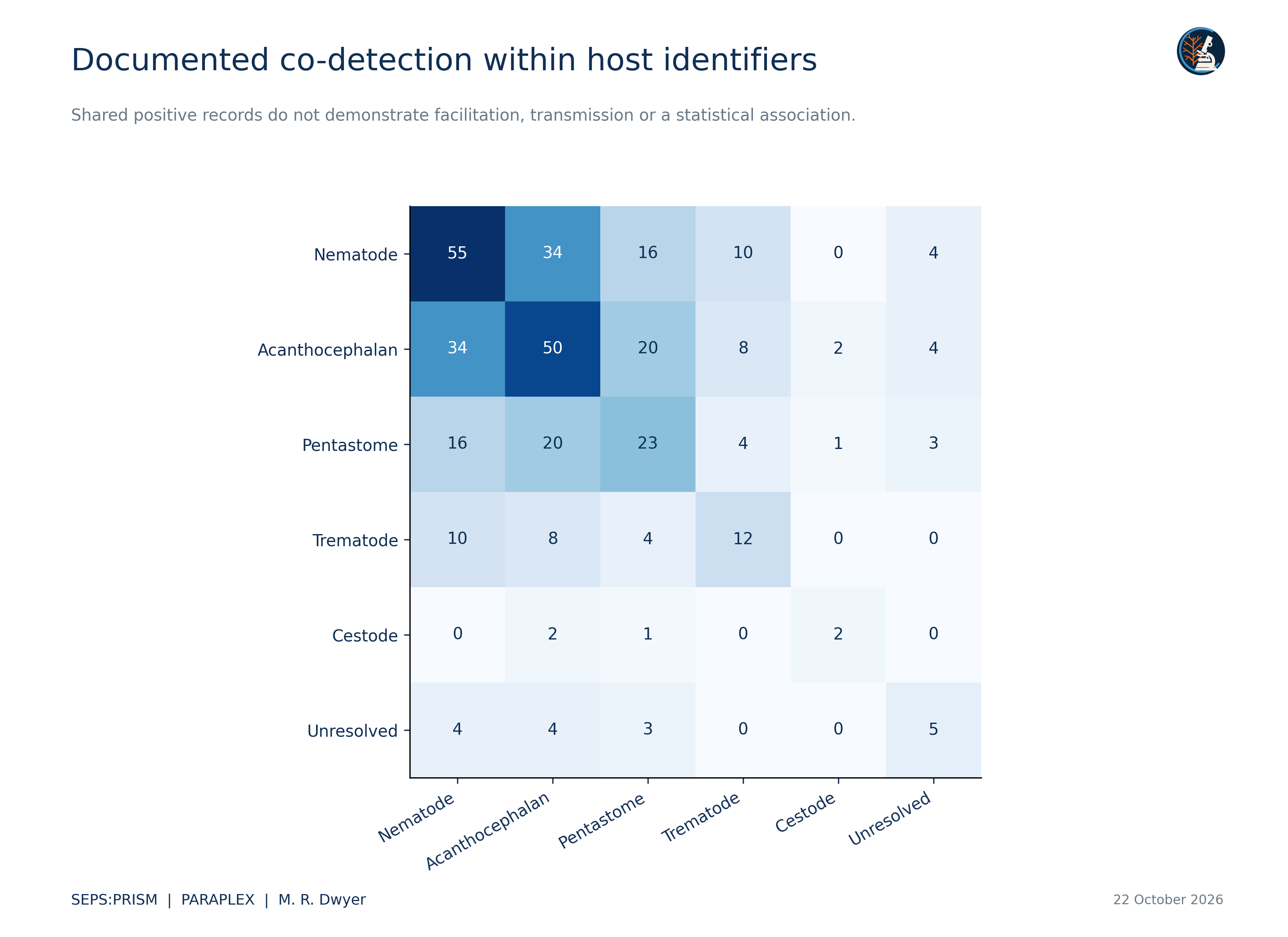
C_jk counts host identifiers with records in both groups, and its diagonal counts hosts with the corresponding group. Forty-seven hosts have at least two recorded groups. This describes documentary co-detection. It does not establish species-level coinfection, interaction strength, facilitation or transmission. We avoid odds ratios and signed ecological network edges because the source does not establish joint target-specific negative examinations. We likewise avoid fitting a richness model to S_h record, which counts broad groups rather than species.
The master workbook contains 28 pentastome-labeled rows linked to 23 reptile hosts. Their exact counts sum to 38. Twenty Basiliscus vittatus hosts contribute 33, two Anolis equestris hosts contribute two and one Thamnophis sauritus contributes three. Removing the snake component gives 22 positive lizard hosts and 35 recorded pentastomes, which agrees with the positive lizard aggregate in the earlier conference presentation (Dwyer, 2026c). This is a concrete numerical overlap between two sources. It supports the aggregate subtotal while leaving the individual image, specimen and identification joins unproven.
The workbook places several pentastome records outside the lung and distinguishes some adults from immature forms. We retain those observations at their original resolution. A pulmonary location does not automatically establish maturity, and a nymph record does not establish definitive-host competence. We do not assign all 38 recorded organisms to Raillietiella orientalis without a linked determination.
The 12 identification rows report M. ingens and a 23 July 2024 identification date. They also refer to material identifiers in a column otherwise labeled Host Number. We normalize MBH and MBHarvey prefixes solely to propose sample-key matches. We preserve every raw label. We do not interpret that identification date as a new collection date or add these quantities to the main series.
Five follow-up rows have candidate links with matching host labels and counts. Three candidate links have different counts. Two have host-label conflicts: one proposed sample belongs to Anolis in the main series and another belongs to Thamnophis sauritus, whereas both follow-ups label Basiliscus vittatus. The two BaVi20 references lack a compatible sample-key match. These conflicts prevent automatic transfer of the species-level identification into the ecological ledger. A candidate match does not substitute for the original vial, image or examination record.
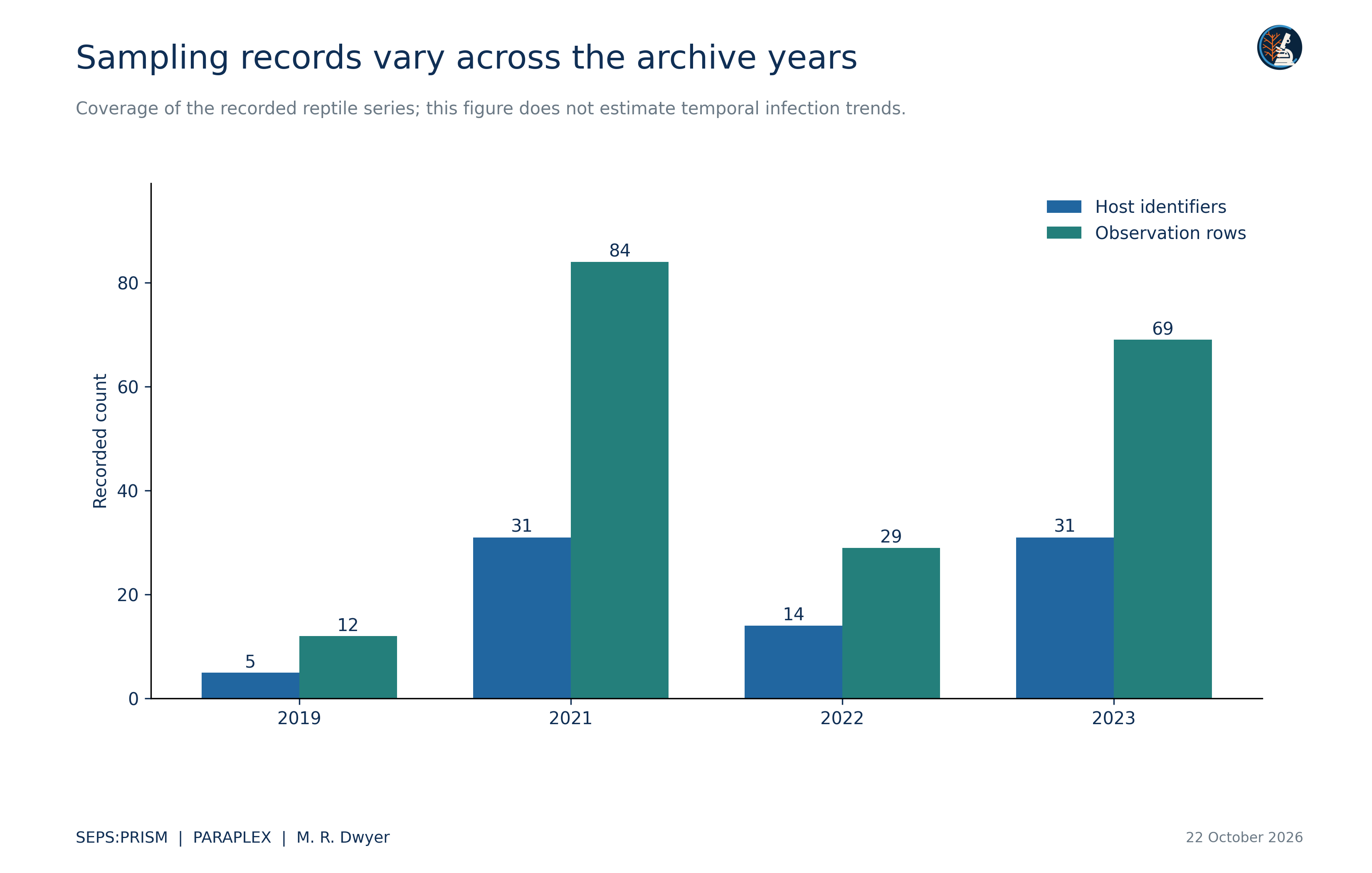
The source dates cover 2019, 2021, 2022 and 2023 in the main reptile section. We count five, 31, 14 and 31 host identifiers in those years, respectively. We preserve original geographic fields but do not infer geographic risk surfaces from these opportunistic records. Different annual row totals can reflect collection effort, host composition or recording practice. They cannot establish a change in infection prevalence without the corresponding sampling design.
The completed analysis supplies useful host associations, source-reported microhabitats and explicit candidates for follow-up identification. It also reconciles the earlier positive lizard pentastome total and prevents double counting of identification material. The next biological inference should begin with the specific missing observation or link, rather than a new plot of uncertain zeros. Original voucher records can resolve the identification conflicts, while examination records can establish which host and organ combinations support denominators.
We preserve the original workbook and its SHA256 digest. Every derived observation retains its worksheet row. Separate files contain the ledger, crosswalk, host matrix, co-detection table, count summaries and follow-up reconciliation. Figures plot those tables without specimen-image post-effects. This documentary analysis leaves population and transmission quantities unestimated where evidence does not support them.
Bush, A. O., Lafferty, K. D., Lotz, J. M., & Shostak, A. W. (1997). Parasitology meets ecology on its own terms: Margolis et al. revisited. Journal of Parasitology, 83(4), 575–583. https://doi.org/10.2307/3284227
Dwyer, M. R. (2026a). SEPS:PRISM methodology reference (Version 1.2, 18 October 2026) [Methodology specification]. Society for Evolutionary Parasite Systematics.
Dwyer, M. R. (2026c). Morphology and host associations of pentastomid parasites in introduced lizards of South Florida 2019 to 2023 [Conference presentation]. Society for Evolutionary Parasite Systematics.
Dwyer, M. R. (2026e). PARAPLEX ecological inference layer for SEPS:PRISM [Working module specification, 22 October 2026]. Society for Evolutionary Parasite Systematics.
Fall2019_Fall2023_NecropsyData_MASTER(1) [Unpublished necropsy workbook]. (n.d.). Supplied research archive. Sheet1, main reptile observations in rows 2–195; amphibian notes in rows 210–215; identification follow-ups in rows 220–231.