
Built from years of fieldwork, necropsy, microscopy, and iteration.
SEPS is an independent research program developing a rigorous bridge between classical parasite systematics and reproducible quantitative evidence.
Not an AI company. Not a black-box diagnostic service.
SEPS began from practical biological work: recovering parasites, documenting hosts and infection sites, acquiring diagnostic images, preserving specimens, and confronting the limits of incomplete evidence.
Computational methods entered later because the archive was becoming too large and heterogeneous to manage consistently by hand. Their role remains deliberately bounded: organize, localize, measure, compare, and document—while expert interpretation retains final authority.
The work did not appear all at once.
Multi-year host records, parasite recovery, preservation, infection-site notes, and specimen photography.
Host-level datasets, prevalence and richness summaries, South Florida risk concepts, and invasive-reptile case work.
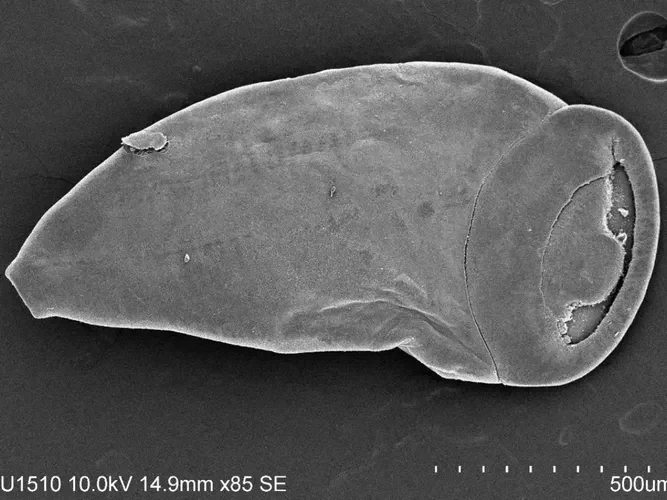
Landmarks, scale-aware imaging, hook and attachment-structure concepts, surface micrographs, and morphometric planning.
Field-level data locks, full-field localization, review boards, masks, claim caps, and a publication roadmap.
What SEPS is trying to protect.
Respect for specimens
Use each specimen carefully, maximize the scientific record it can support, preserve vouchers, and avoid unnecessary collection.
Respect for taxonomy
Keys, type material, published descriptions, expert review, and formal nomenclature remain the basis of defensible identification.
Respect for uncertainty
Unknown, incomplete, damaged, and conflicting records are valid scientific outcomes—not failures to be hidden.
Where the elevator is headed.
Regional specimen–image network
Linked vouchers, standardized image series, ecological metadata, and versioned derived measurements.
Cross-laboratory validation
Protocols and challenge sets that can travel across microscopes, institutions, operators, and parasite groups.
Publication and training pipeline
Independent papers, student projects, technical notes, workshops, and durable public-facing resources.
What support would unlock.
The scientific questions are already defined. Funding changes the speed, scale, independence, and durability of the evidence chain.
Vouchers and confirmation
Specimen curation, expert review, sequencing, and formal linkage between morphology and molecular evidence.
Regional surveillance
Standardized sampling across sites, seasons, host guilds, and native–non-native interfaces.
External validation
New microscopes, operators, laboratories, challenge material, and frozen evaluation cohorts.
Public research products
Peer-reviewed papers, a specimen-linked atlas, reusable training records, and education resources.