Active and emerging projects

Questions large enough to matter. Claims narrow enough to defend.

SEPS organizes projects around biological questions, specimen evidence, and explicit validation gates. “Groundbreaking” is a conclusion—not a starting adjective.

Observed / archivedAnalysis in progressValidation requiredLong-term program
Project portfolio

Six connected investigations.

Each project can stand on its own while contributing to a larger specimen-to-ecosystem evidence system.

Archive active01

Pentastome comparison and host movement

Comparative records integrate host identity, anatomical site, life stage, prevalence, intensity, richness, coinfection, morphology, voucher status, and molecular confirmation.

Core question: Which host–parasite associations represent co-introduction, spillover, native-parasite acquisition, host switching, or a plausible spillback pathway?

Analysis in development02

Apex predators: alligator × Burmese python

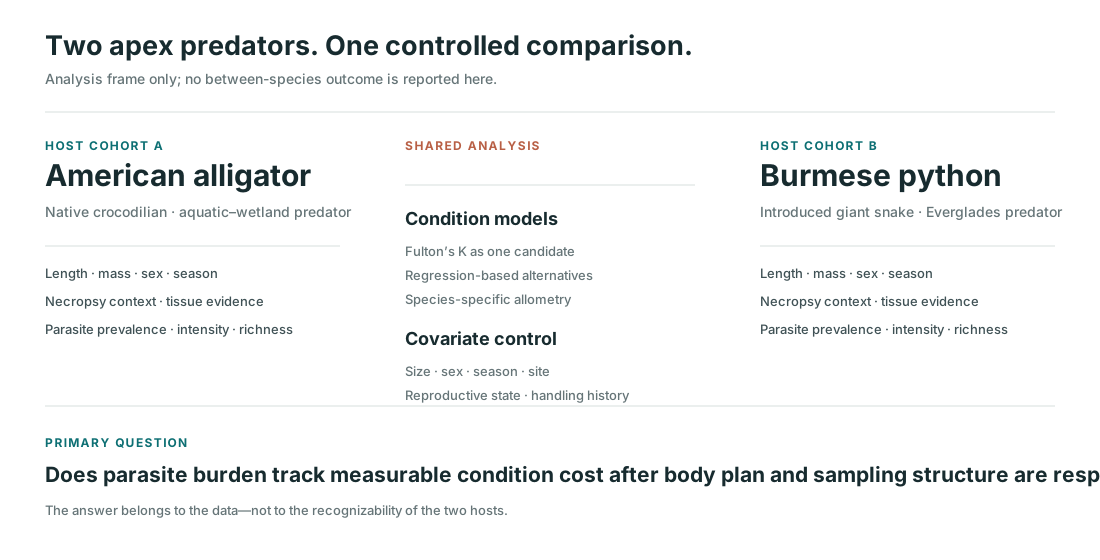
A comparative analysis of parasite burden, body condition, sex, size, season, site, and necropsy context in two iconic South Florida apex predators.

Core question: Does burden track host condition, and can any apparent difference survive species-specific allometry and seasonal confounding?

Imaging series03

Progressing pentastome morphology

Replicated early, intermediate, and mature forms are measured through calibrated whole-body outlines, hook geometry, annulation, body proportions, and fine-scale surface features.

Core question: Which morphological changes are developmental, allometric, host-associated, or taxonomically informative?

Locked test retained04

Recall-first microscope-field localization

A field-level candidate proposal system is evaluated by centroid recall, review burden, category capture, failure modes, and external challenge performance—not by inflated diagnostic language.

Core question: Can heterogeneous fields be triaged reliably enough to make expert review faster without hiding misses?

Case archive05

Early detection and rapid response

The Boa imperator Everglades case connects field detection, rapid coordination, morphology, genetics, necropsy, and ecological context as a model for incipient-invasion documentation.

Core question: What evidence and response architecture turns a rare detection into an actionable, defensible case study?

Long-term06

South Florida specimen–image atlas

A durable regional archive would link hosts, collection events, parasite specimens, images, measurements, vouchers, sequences, review status, and publications.

Core question: Can scattered records become a surveillance network without losing taxonomic or specimen-level context?

Potential national story

Two apex predators, one regional health question.

An alligator–python comparison could attract national attention because the hosts are instantly recognizable and ecologically consequential. The story becomes scientifically durable only when burden, condition, allometry, season, sex, size, and sampling structure are handled transparently.

The site therefore presents the study as an analysis frame rather than announcing which species “fared worse.” That conclusion belongs to the data.

1Freeze inclusion rules and denominators.
2Standardize parasite burden and infection sites.
3Validate condition metrics within each species.
4Model season, sex, size, and site.
5Report association before implying mechanism.
Conceptual comparison of parasite burden and body condition in alligator and Burmese python
Fulton’s K is included as a candidate index, not assumed to be directly comparable across body plans.
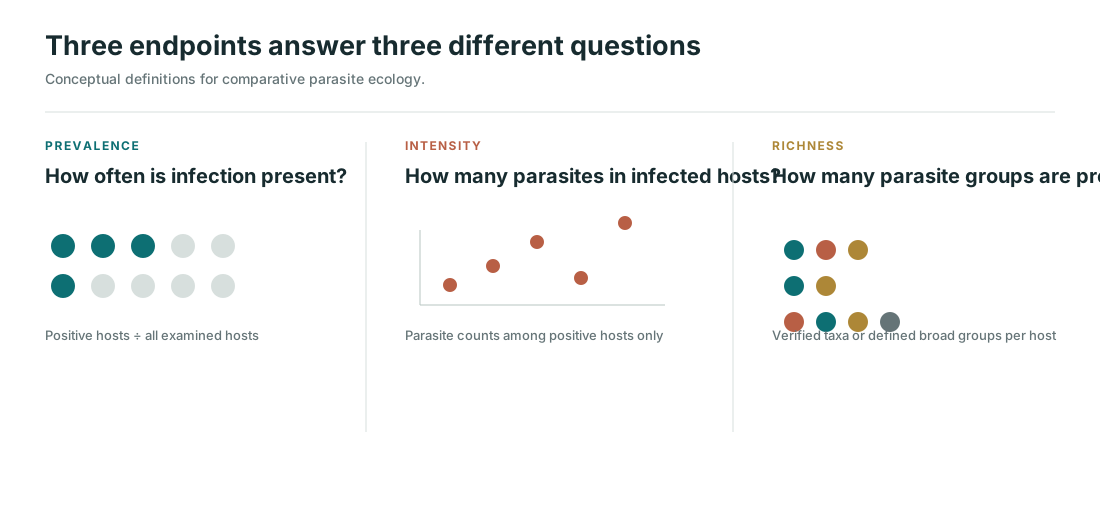
Conceptual definitions of prevalence, intensity and richness
Separating endpoints prevents a high prevalence from being mistaken for a high burden.
Pentastome portfolio

Comparison is strongest when every number keeps its meaning.

Prevalence answers how often infection occurs. Intensity answers how many parasites occur among positive hosts. Richness describes how many parasite groups or verified taxa are present. Infection site and life stage add biological context that a single summary number cannot carry.

Those endpoints can then be linked to host condition, season, habitat, body size, and morphology without collapsing distinct questions into one result.

Evidence standard

What every project must preserve.

Provenance

Host, collection event, location class, date, anatomical site, preservation, and approvals.

Primary evidence

Raw images, specimen condition, calibration status, counts, measurements, and vouchers.

Derived evidence

Masks, landmarks, outlines, model proposals, statistics, and versioned review records.

Claim limits

What is observed, inferred, provisional, molecularly supported, or still review-required.

Collaboration-ready

Bring the missing comparison, specimen, expertise, or validation site.

Priority collaborations include taxonomy, museum curation, molecular confirmation, wildlife health, morphometrics, external detector validation, and long-term data stewardship.