
South Florida Parasite Spillover Initiative
A structured program for studying parasite movement among native and non-native reptiles and amphibians across the urban–wetland interface.
Which host–parasite relationships are changing—and what do those changes mean?
South Florida combines protected wetlands, canals, roadway corridors, suburban habitats, wildlife trade, and an unusually diverse introduced herpetofauna. That landscape creates opportunities for parasite introduction, host switching, range expansion, and altered transmission.
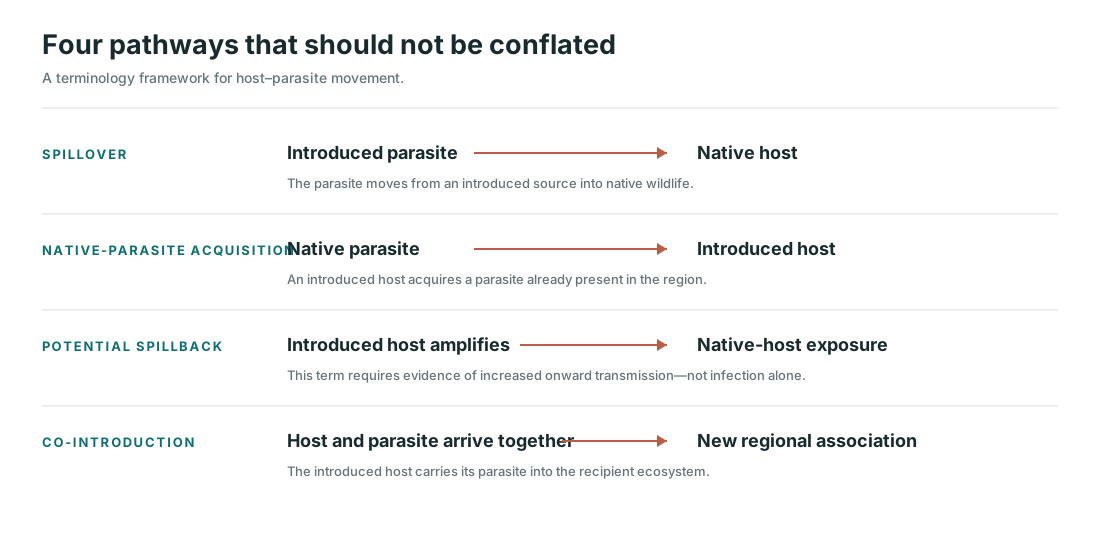
SEPS distinguishes introduced-parasite spillover from native-parasite acquisition and reserves the term spillback for evidence that an introduced host actually increases transmission pressure on native hosts.12
A regional program with defined evidence thresholds.
Host range
Which native and introduced hosts support immature, encysted, or mature parasite stages—and in which anatomical sites?
Transmission geography
How do host movement, habitat edges, season, and locality class relate to parasite occurrence and burden?
Competence and consequence
Does a novel host merely contain a parasite, support development, permit reproduction, or alter onward transmission?
Strong ecological language requires more than an unusual specimen.
Collect the missing evidence—not animals indiscriminately.
The initiative prioritizes animals already available through authorized management removals, road mortality, collaborator necropsies, archived material, and other approved sources. Every specimen should produce the maximum defensible record: host data, necropsy context, parasite inventory, vouchers, calibrated images, and molecular aliquots when appropriate.
Nonlethal sampling and opportunistic material are preferred when they can answer the question. Internal infection site, burden, and life stage often require necropsy, so the program emphasizes careful use of specimens already available through approved work.
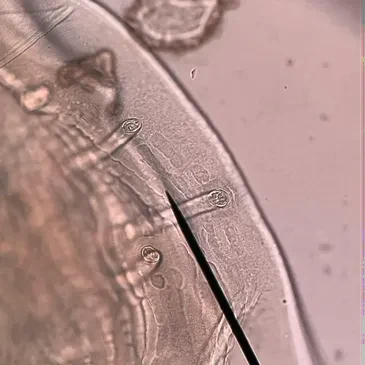
Move from isolated records to an interpretable surveillance network.
Baseline
Establish host, locality, life-stage, and parasite-community baselines across priority corridors and habitat classes.
Signal detection
Identify new host associations, range extensions, unusual burdens, and repeatable morphology shifts without overstating them.
Response
Provide review-ready records that can support targeted re-sampling, molecular confirmation, museum deposition, and agency communication.